The video edit was my bottleneck. Now the podcast is done in an hour.
An AI agent is an employee you have to train, and most operators are still stuck in the chat window. Here is how I train mine and what it gave me back.
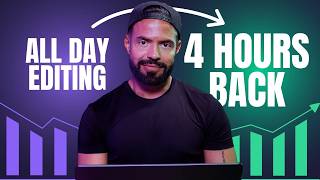
One podcast used to take me four to six hours to edit. Now I finish filming, put the files on the computer in one folder, and the agent is watching that folder. It sends me a notification asking if I want to start the edit. I say yes. An hour later the whole thing is ready, the reels are cut, it is published on YouTube.
In the wedding world I did that for ten years. Video editing was always the constraint. If you want to do more weddings you have to pump more edits, and depending on one person for all of it is a burnout job. There was a ceiling on how many clients I could hold.
I save four hours every day just because of the video edit.
 21:13
21:13
An agent is an employee you have to train
Think of an AI agent as somebody who works for you. You give it the thing that is repetitive, the thing you do every day, the predictable thing. It learns your system and then it runs your system.
The problem is people expect AI to be perfect. You ask for a website and you expect an amazing website back on the first response. When it is not, you complain to it and you start getting generic answers. Complaining is not training.
I have been doing this for about six months and here is what I learned. You want the agent to fail. Give it the task, let it fail, then give it real feedback. This is wrong because one, two and three. Let it finish the next response. Then ask it what it learned from the interaction. It will tell you what it learned. Then you say, next time I ask you to do the same thing, keep learning.
You want the AI to fail. That is when they learn.
 8:10
8:10
When it gets something wrong, tell it exactly why: this is wrong because one, two and three.
Let it finish the next response before you say anything else.
Ask it what it learned from that interaction, and read the answer back.
Tell it that next time you ask for the same thing, it should keep learning.
Chat is not the same as agents
Most people operate in the chat window. In Claude I switch from the chat bubbles over to code, and that is where I talk to the agents. In ChatGPT there is a work tab with the little robot on it asking what we should work on. That is where I can connect files, connect Gmail, connect my website. I can work from my phone as long as the computer is on, so I am walking on the boardwalk and the agents are still running.
One thing to know. On the twenty dollar subscription you run out of tokens fast once you start using agents. Tokens are just how the AI companies measure power, kind of like video games. Every request spends them. When you hit the limit, that is when you move up to pro.
If you have only ever used the chat window, you have not used the part that actually saves you time. Go find the work or code side of the tool you already pay for and give it one repetitive job.
Everyone's flyers are about to look the same
More business owners are generating their own social media flyers now, and content agents are going to take more of the content creation. That is a problem for me, because I do content. The image tool is good. It is also always going to use icons, always over process the image, always sharpen the same way. Your flyer is my flyer with your logo on it and red instead of purple.
They are all going to start to look the same. I have already noticed.
 15:42
15:42
So the way I reinvent myself is by learning the tools. I still do content, but I also know how the agents work. If you are an operator, you do not want to spend three days talking to an agent to automate one thing in your business. You do not have the time. I do it once and then it keeps going.
Generated assets are cheap now, so the asset is not the differentiator. Decide what only you can bring to it before you send the prompt.
Volume, and where it should live
There are two reasons to push volume. One is visibility. You keep showing up until you hit the tipping point, because right now you are invisible online and there is a lot of content being put out. The other is learning. You look at what the analytics say is doing better and you go in that direction.
That is why I keep pointing people at YouTube. On Instagram the video you post today is all the way down the grid in a year. On YouTube it stays there and somebody finds it. I do not even remember my own calisthenics videos from years ago, and they are still there.
 33:59
33:59
If you are a gym owner you are already training and you are already filming. Do the part of the session that happens in one spot, shoot it horizontally, leave enough space in the frame. That is the whole job. Send it over, the agent edits it, cuts the reels, writes the captions off your own past posts and puts one out a day.
Start with the footage you are already shooting. If a recording habit only feeds a feed that buries it, move the long version somewhere it stays findable.
Internet credit
I call what I am building internet credit. X, LinkedIn, YouTube, Spotify, Apple Podcasts. The point is that it is there when the right person looks. If I walk into a client who wants a podcast built, I have my own. That is the proof.
 31:12
31:12
Same reason I published a book print on demand on Amazon, The One Hour Marketing for Business Operators. AI did not write it. It gave me the outline so I could start writing, and it helped edit. I record everything already, discovery calls, voice notes, and I put all those transcripts into one database so I can find the patterns, the angles I keep repeating, the opportunities I have missed. Print on demand means no publisher, no inventory, and you can test different ideas quickly.
I always wanted a fitness YouTube channel and I never did it. Part of it was the editing time. Part of it was that my first thought was that I am not as lean as I think I should be. Then I decided to shoot my own workouts anyway, because if people see a regular guy doing it, they know they can do it.
Cringe is the price and I do not care.
01
Hand the agent the repetitive, predictable work first. That is where the hours come back.
02
Do not complain at the AI. Tell it what was wrong, ask what it learned, tell it to keep learning.
03
Build the library now. Content that stays findable is what gets you in the room later.
You do not have three days to talk to an agent
If you are an operator sitting on unused footage and no time to set any of this up, that is the part I do. Built once, then it keeps going. Tell me what you are already filming.
Send me a text