Your workouts are already filmed. The editing is what kills the channel.
A client films his workouts on an iPhone and sends me the file. An agent cuts it, adds the timers and the music, and publishes it to YouTube. Here is the whole setup.
The editing is what stops you. Not the camera, not the equipment, not the idea. You already record your workouts. You have thought about a channel where you post them so people can follow along. Then you think about sitting down to cut it, and that is where it dies.
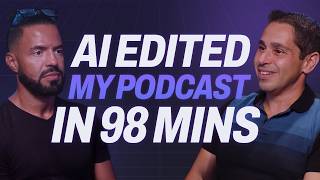
Ten years in photography, video and content, over 400 customers, and I used to spend three to four hours a day editing. Now I do not edit at all. AI does it. I still edit from time to time, but only for fun.
YouTube is worth it, by the way. Once you hit a thousand subscribers and 4,000 watch hours, YouTube starts paying you. It takes six to eight months, probably longer. Do not rush it. Be patient.
 0:50
0:50
The goal isn't to get better at editing. It's that you keep filming the workouts and posting them.
What the client sends me
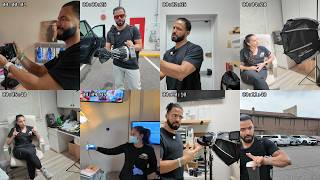
Adam films in his own gym on his iPhone. The instructions were short. Get a cheap tripod off Amazon. Shoot 4K. Expose it correctly. Check you have space on the phone, because a workout runs fifteen to twenty minutes and that is some space. You do not want to be mid workout and find out you ran out.
Two more things. Turn off the gym lights and use the natural light coming in, it looks much better. And frame a little wider than you think, so there is room to crop at the end. We shoot 4K and export 1080 to YouTube.
 2:13
2:13
What landed in my inbox was a 4K HDR file, around 5 gigabytes, two exercises, no notes. I had told him one thing. Hey, workout, just send me your workout.
Put your phone on a cheap tripod and shoot your next workout in 4K.
Frame yourself a little wider than feels right so there is room to crop.
Turn the overhead lights off and use whatever natural light the room has.
Shoot it landscape, not vertical. The shorts come out of the long version later.
What the agent does with it
The intro comes first, explaining what the workout is. If people are following along on YouTube, they want to figure that out at the start. Then a countdown so they can get ready. Then the names and reps of each exercise, the card on the side telling you what is coming next, the timer and the round in the corner. All of it done by the agent.
The colors and the font are his, because his branding is on file. At the end the agent writes a little workout card for the description, every exercise, the reps, how long it runs. That one is selfish. I download these to my phone, play my own music, and repeat the workout by checking the card.
Find one follow along video on YouTube whose layout you like and give it to the agent as the reference. You are not describing a style from nothing, you are pointing at something that already works.
The music used to be the worst part
Finishing the edit was never the end. A fifteen minute video and four tracks of different lengths meant an audio mix on top of everything, and all of it had to be royalty free. That part was terrible.
Now I describe the style to the same agent and it gives me options. In this case ten tracks, ten different ideas, for less than ten cents. I pick one. And I do not do that every time, because the ones I keep become a library and the agent learns what I like. Next time it can do it in one pass. You can hand it your own music too, as long as it is royalty free.
You're building a library, not generating music every time.
Three to four hours became a notification
The clips come in, the agent starts the edit. It takes about fifteen minutes, depending on your machine. A faster computer, a faster edit. Honestly, sometimes the agent is slower than I would be, because I have been editing for more than ten years and I am quick. That is not the point. The point is that it is not my three to four hours anymore. I get a notification on my phone, I watch the preview, I approve, it goes to final render.
 10:02
10:02
What Claude Code actually is
Claude Code is an AI that works on your computer. That is pretty much it. You talk to it the way you talk to ChatGPT. The difference is it can open your files, run the edit, save the video and publish it. I am a big fan of Claude, but you could do this with ChatGPT or Gemini.
One human employee here. One. And a full marketing agency running social media content, YouTube channels, podcasts and Facebook ads for clients. All of that is run by AI agents.
If you have only ever used Claude or ChatGPT as a chat box, that is the gap. Give one of them a file to open and a job to finish, and see what changes.
Shoot it landscape
Anyone running their own workouts can do this. Kettlebells, functional training, yoga, pilates, mobility, strength, stretching. You put the phone on a tripod and you do the workout you were doing anyway. You are probably already posting it, as a reel or a short.
 11:21
11:21
Some people think long form is a waste of time. I am a big believer in YouTube, and ten to fifteen minute follow along workouts are popular there. There is also what happens after. One client is a PT. We film the workouts the same way, AI edits them, and they go on a website where she sells memberships. Another is a nutritionist who talks through hers. Same tripod, same iPhone, same agent.
You're already filming these. They can be your own app or your own course.
Embrace the suck
Patience is the whole thing with AI. At the beginning you are going to suck. The agents make tons of mistakes. Mine failed constantly and I was frustrated. Then one rule landed.
You want your AI agents to fail. Then you provide feedback.
 13:52
13:52
The more feedback you give, the better it gets, and I say a long time on purpose because I want you to be patient. It took me around six months to train my own agent. Now it is on the go and I trust the edits completely. I still review every one of them.
Give it six months before you trust an agent with anything that ships. When it gets something wrong, correct it instead of quietly doing the task yourself.
Why this one is free
There are a lot of coaches on YouTube teaching AI who are trying to sell you something. A school community, a website where you have to purchase something. I just love teaching this stuff, because it has saved me so much time. No kidding.
So the open question is how to hand it over. One way is a GitHub repository with the code for the AI video editor, if you already know Claude Code. The other is an MD file that describes the project, which you open in Claude Code or ChatGPT and use to rebuild the agent yourself. It is not complicated. It is just time with it. Which one would you actually use?
01
The goal is not better editing. It is that you keep filming and keep posting.
02
Let the agent fail and feed it corrections. That is the training, and it takes months.
03
Shoot landscape. The long form is the asset, and the shorts come out of it.
Tell me which way to ship it
Two options on the table. A GitHub repository with the code for the AI video editor, or an MD file that describes the project so you can open it in Claude Code and rebuild the agent yourself. Tell me which one you would actually use.
Send me a text